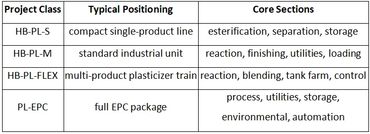
Building on its phthalic anhydride process and downstream equipment capabilities, Tianjin Huabang also provides EPC-based engineering for phthalic anhydride-derived plasticizer production units, including the core reaction, finishing, storage, utility, and packaging sections. These projects are typically developed for clients requiring reliable esterification technology, consistent product quality, efficient heat management, and practical plant automation.


Pulse-Jet Cleaning Principle
Compressed air is released through pulse valves into the filter-bag system, rapidly expanding the bags and dislodging accumulated dust, ensuring stable, long-term operation.
Modular Filter-Bag Architecture
The HB-FMC family is organized in standardized bag-count increments, simplifying selection and scaling.
Stable Filtration Efficiency
The series is intended for high dust-removal efficiency in dry-service applications, with filtration performance dependent on media choice, air-to-cloth ratio, and process conditions.
Adaptable Discharge Arrangement
Depending on project need, the baghouse may be supplied with a hopper, butterfly valve, ash discharge, or screw-conveyor configuration.
Safety and Monitoring Options
The system may include differential-pressure monitoring, dust-concentration monitoring, an explosion-relief interface, and automatic pulse-sequence control.
The esterification section must maintain stable stoichiometry, residence time, and temperature profile to achieve high conversion and consistent acid value. Reactor design, agitation, heat transfer, and alcohol circulation all strongly influence final product quality.
Because esterification is an equilibrium-limited process, efficient removal of reaction water is essential. The EPC basis, therefore, places strong emphasis on overhead condensation, phase separation, reflux control, and, where applicable, vacuum-assisted finishing.
Plasticizer production is heat-intensive but highly amenable to optimization. Integrated heating, condensation, and cooling utility design can improve both operating cost and product stability.
The plant must manage combustible organics, hot liquids, and esterification off-gas in a controlled way. Vent recovery, scrubbers, condensers, flame-safe routing, and electrical-area classification are therefore part of the engineering basis.
Huabang can develop the reactor train around jacketed or coil-equipped vessels, selected agitation patterns, staged feed logic, and controlled overhead removal. Reactor sizing and internals are adapted to the conversion target, viscosity profile, and selected alcohol system.
The overhead system may include a condenser, a phase separator, a reflux arrangement, and a water draw-off logic to maintain reaction progress and protect product quality.
Where lower residual volatiles, better odor profile, or higher product stability are required, the line can incorporate vacuum finishing, stripping, and polishing steps.
The EPC basis includes alcohol storage, intermediate circulation, finished-product tankage, pumping and loading arrangements with instrumentation and interlocks.
The package can incorporate scrubbers, condensers, and VOC management sections for reactor vents, tank breathing, and product finishing services.

The core duty is stable destruction of VOCs and CO without introducing excessive pressure drop or causing catalyst damage under changing gas composition.
Where tail-gas composition permits, the oxidation section can be designed to recover sufficient reaction heat to support steam generation and reduce net utility burden.
Tail-gas units must handle warm-up, low-load operation, and composition fluctuation without thermal shock or unstable reactor conditions. Start-up heaters, bypasses, and interlocks are therefore part of the engineering basis.
Temperature control, contaminant management, flow distribution, and emergency logic must all be designed to extend catalyst life and avoid overheating or localized hot spots.
The tail-gas unit must be engineered so it does not disturb upstream oxidation and recovery sections. Hydraulic balance, backpressure stability, and control logic are therefore essential.
The reactor section is engineered around catalyst performance, gas distribution, thermal uniformity, and maintainability.
Recovered heat can be directed into steam generation and utility integration, turning the environmental unit into an energy-contributing process asset.
Multi-point monitoring and interlocks are used to manage bed temperature, protect the catalyst, and maintain a safe operating range.
The package can be delivered with process, mechanical, piping, electrical, automation, and structural scopes on a coordinated-execution basis.
COPYRIGHT © 2000-2026 TIANJIN HUABANG NEW MATERIAL TECHNOLOGY CO., LTD. - ALL RIGHTS RESERVED.
This website uses cookies. By continuing to use this site, you accept our use of cookies.