EN

Translate:

HuaBang
  • Home
  • Profile
  • Qualification
  • PRODUCT
    • Flaking Cooling Systems
    • Granulation System
    • Packaging System
    • Conveying System
    • VOC Treatmemt
    • Reactor
    • Axial Flow Pump
    • Screening Classification
    • Baghouse Dust Collectors
    • EPC Basis
  • Update
  • BLOG
  • More
    • Home
    • Profile
    • Qualification
    • PRODUCT
      • Flaking Cooling Systems
      • Granulation System
      • Packaging System
      • Conveying System
      • VOC Treatmemt
      • Reactor
      • Axial Flow Pump
      • Screening Classification
      • Baghouse Dust Collectors
      • EPC Basis
    • Update
    • BLOG
HuaBang

EN

  • Home
  • Profile
  • Qualification
  • PRODUCT
    • Flaking Cooling Systems
    • Granulation System
    • Packaging System
    • Conveying System
    • VOC Treatmemt
    • Reactor
    • Axial Flow Pump
    • Screening Classification
    • Baghouse Dust Collectors
    • EPC Basis
  • Update
  • BLOG

Intelligent Packaging System

As a leading global provider of intelligent packaging solutions, we have been deeply involved in automated packaging for many years. We have developed two core models to meet the diverse needs of various industries: the fully automatic small packaging machine and the fully automatic bulk packaging machine. With their precision, efficiency, and flexibility, our equipment is widely used in a full range of applications, including chemicals, food, pharmaceuticals, agriculture, and mining. Our products are exported to international markets such as Russia and Malaysia, and we can provide a whole chain of integrated services from front-end feeding to back-end palletizing, helping enterprises achieve intelligent upgrades. The fully automatic small packaging machine is designed for precision packaging. It is suitable for 10-50 kg bags, meeting the high-precision packaging needs of food additives, pharmaceutical excipients, chemical powders, and other materials. The fully automatic bulk packaging machine focuses on handling bulk materials, with a single-bag capacity of 500 or 1000 kg, suitable for large-scale packaging of chemicals, fertilizers, minerals, and building materials.

High-Precision Weighing: The accuracy for powdered materials can reach ±0.1%, and for granular materials ±0.2%, perfectly meeting the stringent standards of the pharmaceutical, food, and fine chemical industries. We have obtained numerous overseas weighing certifications, including the Russian National Metrology Bureau certification with certification number 94210-24.

Ultra-high-speed production capacity: A single small packaging machine can produce nearly 1300 bags per hour, and the bulk packaging machine can handle almost 12 tons per hour, supporting fully automatic bag feeding, filling, and sealing for paper bags, PE film bags, and woven bags.

Intelligent Production:  Adopting a modular quick-change design, packaging specifications can be switched with one click, improving production efficiency by 50%.

Full environmental compatibility: All our packaging equipment features a complete stainless steel design, ensuring stable operation in harsh environments such as high humidity, high dust, and high corrosivity.

In addition to the leading equipment, we also provide end-to-end support, including front-end automatic feeding systems, intelligent heat-sealing/sewing units, and back-end metal detectors, checkweighers, and palletizing robots, achieving full-process automation from feeding to warehousing.

A scenic view of a mountain range with clear blue skies and lush greenery in the foreground.

Key Highlights

Multi-Bag Adaptability

Supports paper bags, woven bags, and PE film bags; the bag width can be adjusted to meet user requirements; and it is compatible with different sealing methods.

High-Reliability Packaging

Bag breakage rate <0.01%: Through striped interlocking sealing technology (sealing strength ≥30N/15mm), flat and wrinkle-free bag mouth design, combined with a pneumatic tapping device (frequency 10-30Hz) to reduce material voids, significantly reducing the risk of transportation damage.

Re-inspection failure rate <0.2%: Integrated online quality re-inspection system (optional), automatically rejects products exceeding tolerance through visual inspection and weighing feedback, ensuring an overall finished product pass rate of ≥99%.

Precise and Efficient

Servo screw feeding + high-precision weighing sensor (powder accuracy ±0.1%, granular accuracy ±0.2%) are combined with PLC real-time calibration of filling volume, and automatic error compensation technology improves dynamic accuracy by 30%.

Maximum production capacity of up to 500 bags/hour, supports multi-station parallel design.

Intelligent Control

The human-machine interface (HMI) presets 10 recipes, supporting one-key product changeover.

Fault self-diagnosis function: automatic alarm and shutdown in case of bag blockage, empty bags, or material shortage; failure rate <0.5 times/8 hours.

Safe and Environmentally Friendly

Photoelectric emergency stop, dust cover + dust removal interface (dust concentration <5 mg/m³), explosion-proof models meet IP65 protection level.


Packaging — Primary & Secondary

Section Overview

Tianjin Huabang supplies packaging systems as a fully integrated continuation of the downstream solids-handling line. The packaging scope is designed for flakes, granules, and moderately free-flowing powders, with emphasis on clean transfer, stable weighing, dust-controlled filling, and dependable end-of-line automation. The systems are i

Tianjin Huabang supplies packaging systems as a fully integrated continuation of the downstream solids-handling line. The packaging scope is designed for flakes, granules, and moderately free-flowing powders, with emphasis on clean transfer, stable weighing, dust-controlled filling, and dependable end-of-line automation. The systems are intended to connect directly with flakers, conveyors, screening units, storage hoppers, and palletizing equipment, forming a coherent production route from solidification to finished dispatch.

The packaging system is organized in two coordinated levels

Primary Packaging

Secondary Packaging and End-of-Line Automation

Secondary Packaging and End-of-Line Automation

For accurate bag filling, weighing, compaction, and closure of finished products in small-bag or FIBC/ton-bag formats

Secondary Packaging and End-of-Line Automation

Secondary Packaging and End-of-Line Automation

Secondary Packaging and End-of-Line Automation

For case handling, palletizing, wrapping, inspection, and logistics-ready discharge.

This approach allows the line to be configured according to the required degree of automation, plant layout, bag specification, and product characteristics, while maintaining a consistent engineering platform across the project

Product Positioning and Application Range

Huabang packaging systems are intended for dry solids produced from downstream chemical finishing systems, especially:

· flaked products from drum or steel-belt flakers

· granules from cooling and finishing lines

· moderately free-flowing powders with controlled dust characteristics

Conveying-system design is developed around five practical e

Material Form

Layout and Distance

Material Form

Flakes, granules, and moderately free-flowing powders do not behave in the same way. Product geometry determines the most suitable conveying principle, the internal clearances, transfer points, and anti-bridging measures

Process Duty

Layout and Distance

Material Form

Conveying may serve simple transfer, controlled feeding, elevation, buffering, or line balancing. The selected machine must therefore match not only capacity, but also the role it plays in the process

Layout and Distance

Layout and Distance

Containment Requirement

Short transfer between connected equipment may favor screw or vibratory designs, while longer or more complex routing may justify belt or pneumatic systems

Containment Requirement

Containment Requirement

Containment Requirement

Where dust control, odor control, or enclosed operation is required, the conveyor must support sealed interfaces and easy integration with local exhaust or dust-collection systems

Downstream Stability

Containment Requirement

Downstream Stability

Packaging lines, screening systems, and storage hoppers all depend on consistent feed. Conveyors must therefore deliver stable, non-pulsing product flow within the required capacity window

Key Technical Features

Compact and Enclosed Construction

Compact and Enclosed Construction

Compact and Enclosed Construction

Screw conveyors provide a compact mechanical layout and are well-suited to installation beneath flakers, bins, and hoppers. The enclosed casing helps reduce product loss, dust escape, and environmental contamination

Strong Process Integration

Compact and Enclosed Construction

Compact and Enclosed Construction

Because the inlet and outlet arrangement can be adapted easily, screw conveyors are effective as direct interconnecting equipment between upstream and downstream machines. This makes them particularly useful in packaged skid systems and compact plant layouts

Flexible Feeding Characteristics

Compact and Enclosed Construction

Flexible Feeding Characteristics

Short transfer between connected equipment may favor screw or vibratory designs, while longer or more complex routing may justify belt or pneumatic systems

Containment Requirement

Containment Requirement

Flexible Feeding Characteristics

Where dust control, odor control, or enclosed operation is required, the conveyor must support sealed interfaces and easy integration with local exhaust or dust-collection systems

Downstream Stability

Containment Requirement

Downstream Stability

Packaging lines, screening systems, and storage hoppers all depend on consistent feed. Conveyors must therefore deliver stable, non-pulsing product flow within the required capacity window

Screw Conveyor Selection Table

Common design basis for the series

Execution: tubular or U-trough screw conveyor
Installation: horizontal or inclined
Drive: geared motor with variable-frequency option
Construction: carbon steel, SS304 or SS316L according to service requirement

Actual capacity depends on bulk density, product flowability, inclination, moisture level, inlet condition, and required fill factor

Customization Options

Available options include:

  • shafted or shaftless screw arrangement
  • variable pitch or special flight design
  • quick-open covers for cleaning and inspection
  • anti-bridging feed hopper
  • wear-resistant liners
  • gas-tight or dust-tight sealing arrangement
  • feed-control instrumentation and interlocks
  • explosion-proof motor and instrument package
Screw Conveyor Selection Table

Common design basis for the series

Execution: tubular or U-trough screw conveyor
Installation: horizontal or inclined
Drive: geared motor with variable-frequency option
Construction: carbon steel, SS304 or SS316L according to service requirement

Actual capacity depends on bulk density, product flowability, inclination, moisture level, inlet condition, and required fill factor

Customization Options

Available options include:

  • shafted or shaftless screw arrangement
  • variable pitch or special flight design
  • quick-open covers for cleaning and inspection
  • anti-bridging feed hopper
  • wear-resistant liners
  • gas-tight or dust-tight sealing arrangement
  • feed-control instrumentation and interlocks
  • explosion-proof motor and instrument package

Bucket Elevators

Product Description

Bucket elevators are used where material must be lifted vertically with high efficiency and minimal floor space. They are especially suitable for transferring flakes or granules from lower process elevations to storage bins, buffer hoppers, or packaging floors.

Material is loaded into a series of buckets attached to a belt or chain. The bu

Bucket elevators are used where material must be lifted vertically with high efficiency and minimal floor space. They are especially suitable for transferring flakes or granules from lower process elevations to storage bins, buffer hoppers, or packaging floors.

Material is loaded into a series of buckets attached to a belt or chain. The buckets travel upward within an enclosed casing and discharge the material at the top through centrifugal or gravity-type unloading, depending on product behavior and system design.

Typical Applications

Bucket elevators are commonly used for:

  • lifting flaked product to storage silos or day bins
  • feeding elevated screening or packaging stations
  • vertical transfer in multi-floor process buildings
  • space-efficient integration into compact production layouts

Key Technical Features

Efficient Vertical Transfer

Good Capacity-to-Footprint Ratio

Good Capacity-to-Footprint Ratio

Bucket elevators provide a large vertical lift within a small footprint, making them well-suited to plants where horizontal space is limited

Good Capacity-to-Footprint Ratio

Good Capacity-to-Footprint Ratio

Good Capacity-to-Footprint Ratio

Compared with inclined conveyors that occupy large floor space, the bucket elevator offers a cleaner, more compact route for product elevation

Enclosed Product Path

Configurable Bucket and Discharge Design

Configurable Bucket and Discharge Design

The closed casing supports cleaner handling and reduced material loss. It also makes integration with dust control easier in areas where product fines may be present

Configurable Bucket and Discharge Design

Configurable Bucket and Discharge Design

Configurable Bucket and Discharge Design

Bucket shape, spacing, and discharge arrangement can be selected to suit flakes, granules, or other bulk solids, reducing material hang-up and improving discharge stability

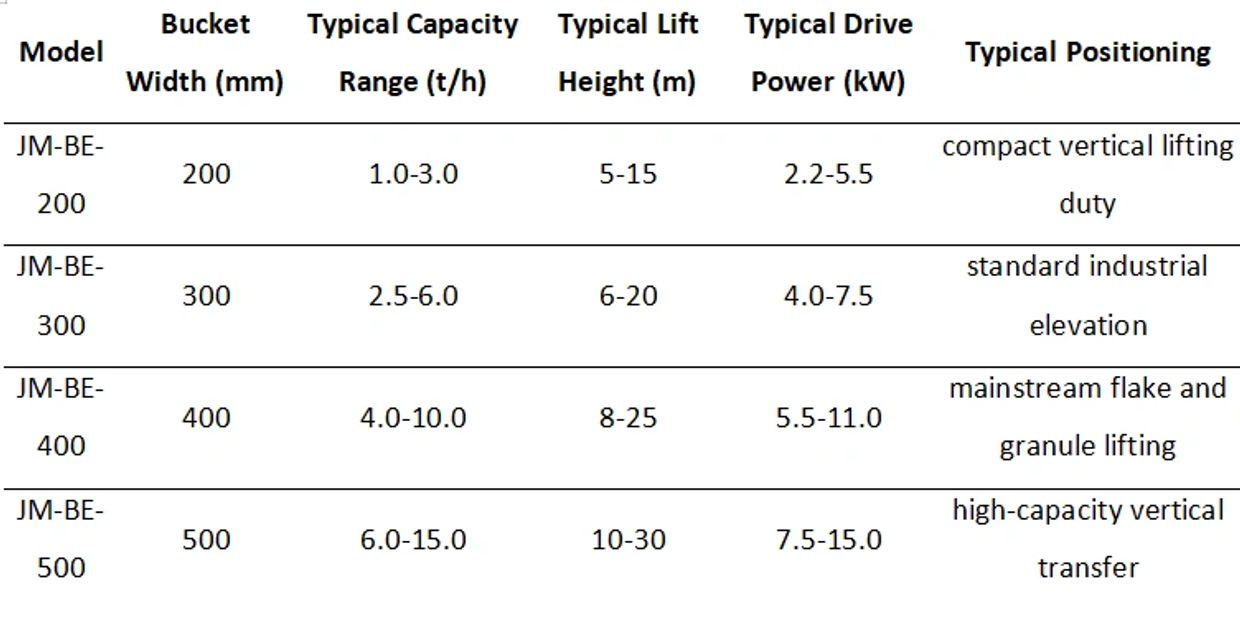
Bucket Elevator Selection Table

Common design basis for the series

Execution: belt or chain type
Construction: carbon steel, SS304 or SS316L
Arrangement: vertical lift with enclosed casing

Actual performance depends on product bulk density, bucket fill efficiency, lift height, and discharge behavior

Customization Options

Available options include:

  • belt-type or chain-type arrangement
  • anti-backstop device
  • explosion relief and venting interface
  • inspection doors and maintenance platforms
  • wear-resistant boot section
  • level switch and blockage alarm
  • integrated inlet hopper and discharge chute design
Belt Conveyors and Belt Feeders

Product Description

Belt conveyors are selected for gentle, stable transfer over medium distances. They are especially suitable for flakes and granules that should be handled with minimal breakage or compression.

In a belt conveyor, the product travels on a continuously moving belt supported by rollers or a slider bed. Because the product rests on the belt ra

Belt conveyors are selected for gentle, stable transfer over medium distances. They are especially suitable for flakes and granules that should be handled with minimal breakage or compression.

In a belt conveyor, the product travels on a continuously moving belt supported by rollers or a slider bed. Because the product rests on the belt rather than being mechanically pushed or agitated, this conveying principle is well-suited to applications where product preservation and clean discharge are important.

Typical Applications

Belt conveyors are commonly used for:

  • transfer of flaked product to screening or packaging
  • gentle movement of the finished product to storage
  • horizontal or mildly inclined transport between process areas
  • discharge from the breaker, screener, or inspection station

Key Technical Features

Gentle Product Handling

Gentle Product Handling

Gentle Product Handling

The belt conveyor is often preferred where flake integrity must be preserved and product attrition minimized

Stable Continuous Flow

Gentle Product Handling

Gentle Product Handling

The belt provides a smooth conveying profile with minimal pulsation, which is beneficial when downstream equipment requires a steady and predictable product load

Flexible Layout

Adaptable as Conveyor or Feeder

Adaptable as Conveyor or Feeder

The machine can be configured with different lengths, inclinations, and discharge arrangements to suit the plant layout

Adaptable as Conveyor or Feeder

Adaptable as Conveyor or Feeder

Adaptable as Conveyor or Feeder

With proper weighing or speed control, the same platform can be used not only for transport but also for controlled feeding to downstream equipment

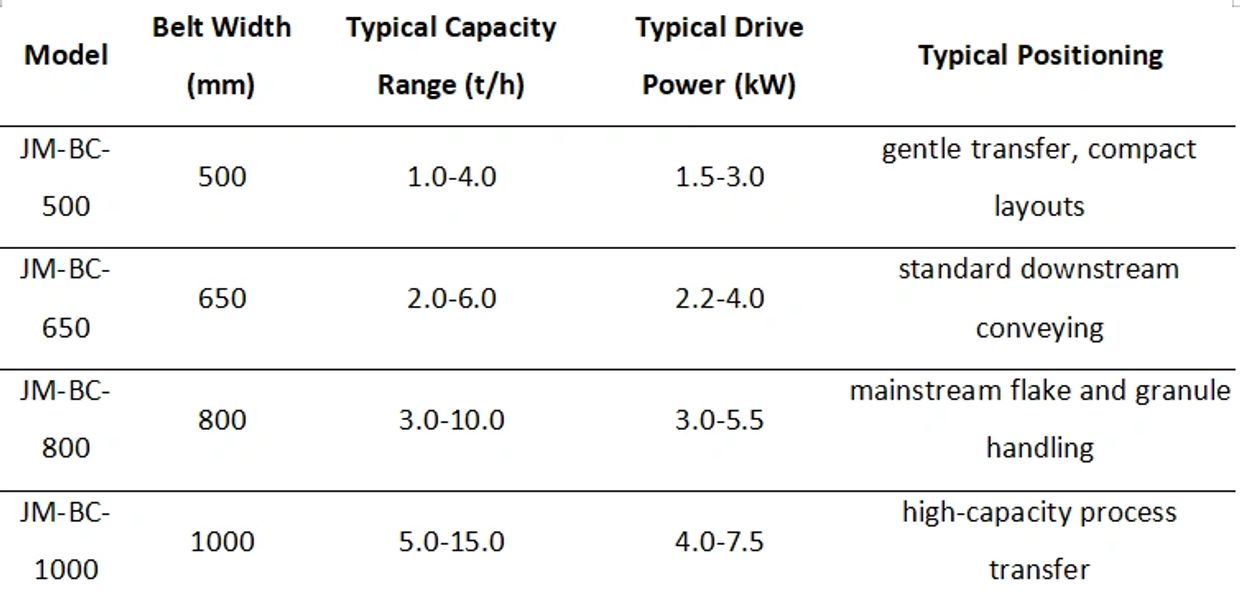
Belt Conveyor Selection Table

Common design basis for the series

Belt width: selected according to capacity and product bed depth
Construction: carbon steel or stainless steel frame
Belt type: smooth, cleated or food/chemical-grade according to service

Actual capacity depends on material bulk density, belt speed, belt inclination, and allowable bed depth

Customization Options

Available options include:

  • smooth or cleated belt
  • enclosed covers and side sealing
  • belt weighing arrangement
  • receiving hopper and discharge chute
  • support legs, platforms, and walkways
  • integrated metal detector or checkweigher interface
  • reversible or fixed-direction operation

Vibratory Conveyors

Product Description

Vibratory conveyors provide controlled movement of solids through vibration rather than continuous dragging or pushing by a mechanical element. They are especially suitable for applications where gentle handling, controlled spread, and clean discharge are required.

The conveyor tray is excited by a vibratory drive, causing the product to a

Vibratory conveyors provide controlled movement of solids through vibration rather than continuous dragging or pushing by a mechanical element. They are especially suitable for applications where gentle handling, controlled spread, and clean discharge are required.

The conveyor tray is excited by a vibratory drive, causing the product to advance in small repeated movements. Because the product is moved in a shallow bed with limited mechanical compression, this method can be beneficial for fragile flakes or for controlled product distribution ahead of screening or packaging.

Typical Applications

Vibratory conveyors are commonly used for:

  • flake discharge and spreading
  • transfer to screeners or inspection points
  • controlled feeding to packaging or accumulation hoppers
  • low-breakage movement of fragile products

Key Technical Features

Gentle Product Transport

Good for Controlled Distribution

Good for Controlled Distribution

The shallow-bed transport mechanism can reduce product degradation compared with more aggressive conveying methods

Good for Controlled Distribution

Good for Controlled Distribution

Good for Controlled Distribution

Vibratory conveyors are useful when the product needs to be spread evenly before entering another machine

Compact and Clean Design

Simple Mechanical Principle

Simple Mechanical Principle

The equipment can be built in a relatively compact format and is easy to integrate into enclosed or semi-enclosed process arrangements

Simple Mechanical Principle

Simple Mechanical Principle

Simple Mechanical Principle

With fewer moving internal contact components than some other conveyor types, the vibratory conveyor can provide reliable service within its proper duty range

Vibratory Conveyor Selection Table

Actual capacity depends on product size, bed depth, vibration setting, and required conveying length

COPYRIGHT © 2000-2026 TIANJIN HUABANG NEW MATERIAL TECHNOLOGY  CO., LTD. -  ALL RIGHTS RESERVED.

  • Home
  • Profile
  • Qualification
  • Flaking Cooling Systems
  • Granulation System
  • Packaging System
  • Conveying System
  • VOC Treatmemt
  • Reactor
  • Axial Flow Pump
  • Screening Classification
  • Baghouse Dust Collectors
  • EPC Basis
  • Update
  • BLOG

Powered by

Cookie Policy

This website uses cookies. By continuing to use this site, you accept our use of cookies.

Accept & Close