

1. Product Description:
To complete the briquetting and granulating package, Huabang also supplies downstream vibratory screening systems for size classification, fines removal, and product finishing. In complete-line applications, the screening unit is typically installed immediately downstream of the briquetter or granulator to separate qualified product from oversize and fines before conveying and packaging.
2. Key features:
2.1 multi-deck screening arrangement
2.2 high screening efficiency for granules and briquettes
2.3 stainless-steel product-contact parts
2.4 enclosed operation for dust control
2.5 rapid screen change, typically within 3-5 minutes
2.6 single or multi-layer deck arrangement
3. System Integration
Huabang’s briquetting and granulating systems can be delivered as stand-alone machines or as complete downstream modules including:
3.1 feed hopper and metering equipment
3.2 dry roller briquetter or steel-belt granulator
3.3 hydraulic and local control system
3.4 vibratory screener
3.5 recycle and fines return logic
3.6 discharge conveyor
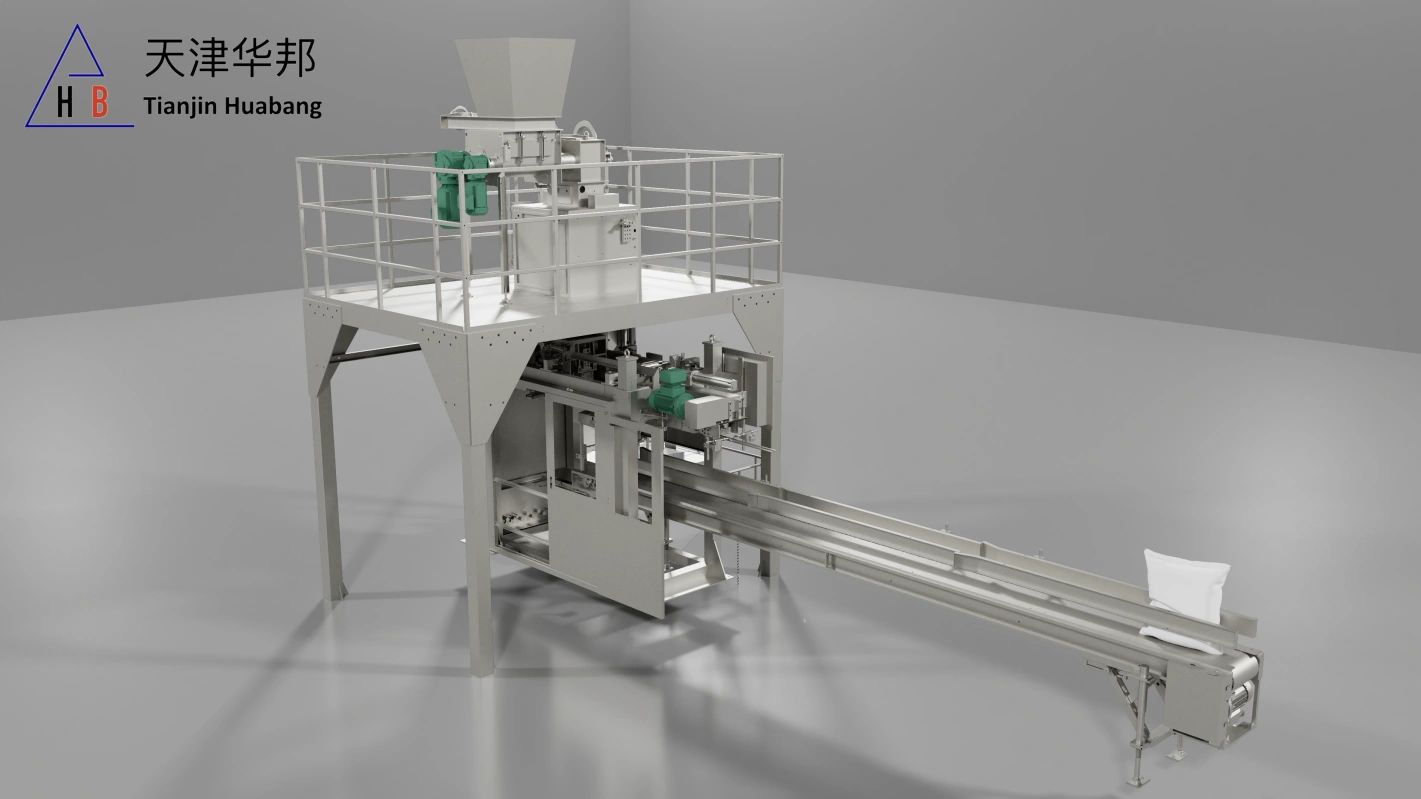
3.7 storage hopper and bagging interface
3.8 dust collection and local aspiration connections
This integrated approach allows the shaping section to function as a stable bridge between melt solidification or raw powder handling on the upstream side and conveying, storage and packaging on the downstream side.
Tianjin Huabang supplies conveying systems as part of an integrated downstream solids-handling platform for flakes, granules, and moderately free-flowing powders. These systems are engineered to connect flaking, screening, storage, and packaging in a stable, low-loss, and plant-friendly manner. The conveying portfolio is intended for cont
Tianjin Huabang supplies conveying systems as part of an integrated downstream solids-handling platform for flakes, granules, and moderately free-flowing powders. These systems are engineered to connect flaking, screening, storage, and packaging in a stable, low-loss, and plant-friendly manner. The conveying portfolio is intended for continuous industrial duty in chemical and related process industries, with emphasis on controlled transfer, enclosed operation, equipment compatibility, and straightforward integration into automated production lines.
In practical project execution, conveying equipment is not selected as an isolated utility. It is selected as a process link that must match the material form, conveying distance, required elevation, dust-control philosophy, plant layout, and downstream feeding precision. For this reason, Huabang organizes its conveying solutions into several complementary equipment families rather than promoting a single universal design.
Huabang conveying systems are designed for industrial production environments in which reliability, containment, and maintainability are as important as nominal throughput. The engineering focus is not only on moving the product, but on preserving product quality and ensuring stable operation of the full line.
This is particularly importan
Huabang conveying systems are designed for industrial production environments in which reliability, containment, and maintainability are as important as nominal throughput. The engineering focus is not only on moving the product, but on preserving product quality and ensuring stable operation of the full line.
This is particularly important in downstream systems handling:
Product Description
Screw conveying systems are among the most practical and widely used transfer methods for the enclosed movement of flakes, granules, and moderately free-flowing solids. They are particularly suitable for short- to medium transfer distances and for direct connections between process equipment such as flakers, hoppers, screeners, and bagging machines.
The system consists of a rotating screw inside a trough or tubular casing. As the screw rotates, the material is advanced along the conveyor axis and discharged at the outlet. The design can be adapted for horizontal, inclined, and selected short vertical duties, depending on product behavior and required feed stability.
Typical Applications
Screw conveyors are commonly selected for:
· flaker discharge to screening or intermediate collection
· hopper discharge to packaging systems
· transfer of granules to storage bins
· controlled metering into bagging or weighing equipment
· enclosed transfer where dust reduction is required
Key Technical Features
Compact and Enclosed Construction
Screw conveyors provide a compact mechanical layout and are well-suited to installation beneath flakers, bins, and hoppers. The enclosed casing helps reduce product loss, dust escape, and environmental contamination.
Strong Process Integration
Because the inlet and outlet arrangement can be adapted easily, screw conveyors are effective as direct interconnecting equipment between upstream and downstream machines. This makes them particularly useful in packaged skid systems and compact plant layouts.
Flexible Feeding Characteristics
The same basic design can be used for either transfer or controlled feed. With appropriate speed control and screw geometry, the machine can provide relatively stable discharge into weighers, packaging machines, or secondary conveyors.
Adaptability to Product Condition
Pitch, shaft design, screw diameter, and casing geometry can be selected according to whether the product is flake-like, granular, warm, light-density, or somewhat cohesive.
Material and Surface Options
Contact parts may be supplied in carbon steel, SS304, or SS316L, with surface treatment or liners selected according to corrosion, cleanability, and wear requirements.
Screw Conveyor Selection Table
Common design basis for the series
Execution: tubular or U-trough screw conveyor
Installation: horizontal or inclined
Drive: geared motor with variable-frequency option
Construction: carbon steel, SS304 or SS316L according to service requirement
Customization Options
Available options include:
· shafted or shaftless screw arrangement
· variable pitch or special flight design
· quick-open covers for cleaning and inspection
· anti-bridging feed hopper
· wear-resistant liners
· gas-tight or dust-tight sealing arrangement
· feed-control instrumentation and interlocks
· explosion-proof motor and instrument package
Personalized service tailored to your unique needs.
Experienced professionals dedicated to your success.
Actual capacity depends on bulk density, product flowability, inclination, moisture level, inlet condition, and required fill factor.

Flakes, granules, and moderately free-flowing powders do not behave in the same way. Product geometry determines the most suitable conveying principle, the internal clearances, transfer points, and anti-bridging measures.
Conveying may serve simple transfer, controlled feeding, elevation, buffering, or line balancing. The selected machine must therefore match not only capacity, but also the role it plays in the process.
Short transfer between connected equipment may favor screw or vibratory designs, while longer or more complex routing may justify belt or pneumatic systems.
Where dust control, odor control, or enclosed operation is required, the conveyor must support sealed interfaces and easy integration with local exhaust or dust-collection systems.
Packaging lines, screening systems, and storage hoppers all depend on consistent feed. Conveyors must therefore deliver stable, non-pulsing product flow within the required capacity window.
Bucket elevators are used where material must be lifted vertically with high efficiency and minimal floor space. They are especially suitable for transferring flakes or granules from lower process elevations to storage bins, buffer hoppers, or packaging floors.
Material is loaded into a series of buckets attached to a belt or chain. The buckets travel upward within an enclosed casing and discharge the material at the top through centrifugal or gravity-type unloading, depending on product behavior and system design.
Bucket elevators are commonly used for:
lifting flaked product to storage silos or day bins
Efficient Vertical Transfer
Bucket elevators provide a large vertical lift within a small footprint, making them well-suited to plants where horizontal space is limited.
Good Capacity-to-Footprint Ratio
Compared with inclined conveyors that occupy large floor space, the bucket elevator offers a cleaner, more compact route for product elevation.
Enclosed Product Path
The closed casing supports cleaner handling and reduced material loss. It also makes integration with dust control easier in areas where product fines may be present.
Configurable Bucket and Discharge Design
Bucket shape, spacing, and discharge arrangement can be selected to suit flakes, granules, or other bulk solids, reducing material hang-up and improving discharge stability.
Actual performance depends on product bulk density, bucket fill efficiency, lift height, and discharge behavior.
Available options include:
Sunday Supper ClubProduct form: granules, strips, flakes, or sheet-broken solids
Cooling method: continuous spray cooling under a steel belt
Execution: standard, enclosed, or customized distributor package
Actual output depends on melt viscosity, melting point, distributor design, particle geometry, layer thickness, belt speed, cooling-water temperature, and required discharge condition.

Belt conveyors are selected for gentle, stable transfer over medium distances. They are especially suitable for flakes and granules that should be handled with minimal breakage or compression.
In a belt conveyor, the product travels on a continuously moving belt supported by rollers or a slider bed. Because the product rests on the belt ra
Belt conveyors are selected for gentle, stable transfer over medium distances. They are especially suitable for flakes and granules that should be handled with minimal breakage or compression.
In a belt conveyor, the product travels on a continuously moving belt supported by rollers or a slider bed. Because the product rests on the belt rather than being mechanically pushed or agitated, this conveying principle is well-suited to applications where product preservation and clean discharge are important.
Belt conveyors are commonly used for:
Gentle Product Handling
The belt conveyor is often preferred where flake integrity must be preserved and product attrition minimized.
Stable Continuous Flow
The belt provides a smooth conveying profile with minimal pulsation, which is beneficial when downstream equipment requires a steady and predictable product load.
Flexible Layout
The ma
Gentle Product Handling
The belt conveyor is often preferred where flake integrity must be preserved and product attrition minimized.
Stable Continuous Flow
The belt provides a smooth conveying profile with minimal pulsation, which is beneficial when downstream equipment requires a steady and predictable product load.
Flexible Layout
The machine can be configured with different lengths, inclinations, and discharge arrangements to suit the plant layout.
Adaptable as Conveyor or Feeder
With proper weighing or speed control, the same platform can be used not only for transport but also for controlled feeding to downstream equipment.

Vibratory conveyors provide controlled movement of solids through vibration rather than continuous dragging or pushing by a mechanical element. They are especially suitable for applications where gentle handling, controlled spread, and clean discharge are required.
The conveyor tray is excited by a vibratory drive, causing the product to a
Vibratory conveyors provide controlled movement of solids through vibration rather than continuous dragging or pushing by a mechanical element. They are especially suitable for applications where gentle handling, controlled spread, and clean discharge are required.
The conveyor tray is excited by a vibratory drive, causing the product to advance in small repeated movements. Because the product is moved in a shallow bed with limited mechanical compression, this method can be beneficial for fragile flakes or for controlled product distribution ahead of screening or packaging.
Vibratory conveyors are commonly used for:
1. flake discharge and spreading
transfer to screeners or inspection points
2. controlled feeding to packaging or accumulation hoppers
3. low-breakage movement of fragile products
Gentle Product Transport
The shallow-bed transport mechanism can reduce product degradation compared with more aggressive conveying methods.
Good for Controlled Distribution
Vibratory conveyors are useful when the product needs to be spread evenly before entering another machine.
Compact and Clean Design
The equipment can be built in a relat
Gentle Product Transport
The shallow-bed transport mechanism can reduce product degradation compared with more aggressive conveying methods.
Good for Controlled Distribution
Vibratory conveyors are useful when the product needs to be spread evenly before entering another machine.
Compact and Clean Design
The equipment can be built in a relatively compact format and is easy to integrate into enclosed or semi-enclosed process arrangements.
Simple Mechanical Principle
With fewer moving internal contact components than some other conveyor types, the vibratory conveyor can provide reliable service within its proper duty range.

Actual capacity depends on product size, bed depth, vibration setting, and required conveying length.
Pneumatic conveying systems are used where enclosed transfer over longer distances is required, or where the routing flexibility of pipework offers a strong plant-layout advantage. These systems are generally applied to granules and selected powders rather than fragile flakes, unless the product can tolerate the conveying conditions.
Mater
Pneumatic conveying systems are used where enclosed transfer over longer distances is required, or where the routing flexibility of pipework offers a strong plant-layout advantage. These systems are generally applied to granules and selected powders rather than fragile flakes, unless the product can tolerate the conveying conditions.
Material is introduced into an air stream and conveyed through a pipeline to the receiving point. Depending on product characteristics and process requirements, the system may be designed as a dilute-phase or denser, lower-velocity transfer.
Highly Enclosed Transfer Path
The pipeline system provides robust containment and helps reduce dust emissions into the plant environment.
Flexible Routing
Pipelines can be routed around structural and layout constraints more easily than many mechanical conveyors.
Clean Plant Integration
Pneumatic systems are suitable where material transfer
Highly Enclosed Transfer Path
The pipeline system provides robust containment and helps reduce dust emissions into the plant environment.
Flexible Routing
Pipelines can be routed around structural and layout constraints more easily than many mechanical conveyors.
Clean Plant Integration
Pneumatic systems are suitable where material transfer must be combined with tidy plant layout and minimal open handling.
Configurable Receiving and Filtering
The system may include filters, receivers, rotary valves, and air-material separation arrangements, depending on the product and duty.
Available options include:
1. vacuum or pressure mode
2. receiver and filter module
3. rotary valve or screw feeder inlet
4. anti-abrasion elbows
5. explosion isolation provisions
6. PLC-based pressure and sequence control
7. integration with silo, hopper, and bagging systems
Screw conveyors are generally preferred for compact, enclosed transfer between directly connected machines.
Bucket elevators are preferred where vertical lifting is necessary and floor space is limited.
Belt conveyors are preferred where gentle product handling and steady flow are critical.
Vibratory conveyors are preferred where controlled
Screw conveyors are generally preferred for compact, enclosed transfer between directly connected machines.
Bucket elevators are preferred where vertical lifting is necessary and floor space is limited.
Belt conveyors are preferred where gentle product handling and steady flow are critical.
Vibratory conveyors are preferred where controlled spread, low breakage, or light-duty transfer is required.
Pneumatic conveying is preferred where full enclosure, longer routing flexibility, or dust-controlled transfer is the primary requirement.
Conveying equipment can be supplied in carbon steel, SS304, or SS316L, depending on corrosion level, hygiene requirements, and client specifications. Contact surfaces, seals, chutes, and hoppers are selected according to product behavior and service environment.
The control philosophy may include:
· variable-frequency speed control
· running
Conveying equipment can be supplied in carbon steel, SS304, or SS316L, depending on corrosion level, hygiene requirements, and client specifications. Contact surfaces, seals, chutes, and hoppers are selected according to product behavior and service environment.
The control philosophy may include:
· variable-frequency speed control
· running and blockage interlocks
· bin level and no-flow monitoring
· overload protection
· local emergency stop and maintenance safety interlocks
· communication with upstream flaker and downstream packaging control systems
Where required, systems can be supplied in an explosion-proof configuration and integrated into a broader plant automation architecture.
Huabang conveying systems can be delivered as stand-alone machines or as part of a complete downstream solids-handling line. A typical integrated scope may include flaker discharge, intermediate conveying, screening, storage hopper, weighing feed, small-bag packaging, ton-bag filling, and associated dust-control interfaces. This integrate
Huabang conveying systems can be delivered as stand-alone machines or as part of a complete downstream solids-handling line. A typical integrated scope may include flaker discharge, intermediate conveying, screening, storage hopper, weighing feed, small-bag packaging, ton-bag filling, and associated dust-control interfaces. This integrated capability is especially valuable in chemical production lines where stable product transfer is essential to packaging accuracy, plant cleanliness, and overall operating reliability.
Available options include:
1. vacuum or pressure mode
2. receiver and filter module
3. rotary valve or screw feeder inlet
4. anti-abrasion elbows
5. explosion isolation provisions
6. PLC-based pressure and sequence control
7. integration with silo, hopper, and bagging systems
Screw conveyors are generally preferred for compact, enclosed transfer between directly connected machines.
Bucket elevators are preferred where vertical lifting is necessary and floor space is limited.
Belt conveyors are preferred where gentle product handling and steady flow are critical.
Vibratory conveyors are preferred where controlled
Screw conveyors are generally preferred for compact, enclosed transfer between directly connected machines.
Bucket elevators are preferred where vertical lifting is necessary and floor space is limited.
Belt conveyors are preferred where gentle product handling and steady flow are critical.
Vibratory conveyors are preferred where controlled spread, low breakage, or light-duty transfer is required.
Pneumatic conveying is preferred where full enclosure, longer routing flexibility, or dust-controlled transfer is the primary requirement.
Pneumatic Conveying Selection Table
Common design basis for the series
Execution: pressure or vacuum conveying
Material form: granules and selected powders
Construction: carbon steel or stainless steel pipeline and receiver
Actual performance depends on particle size, density, friability, line routing, conveying pressure, and air-to-solids ratio.For practical project use, conveying systems should be selected based on the duty rather than on machine category alone.
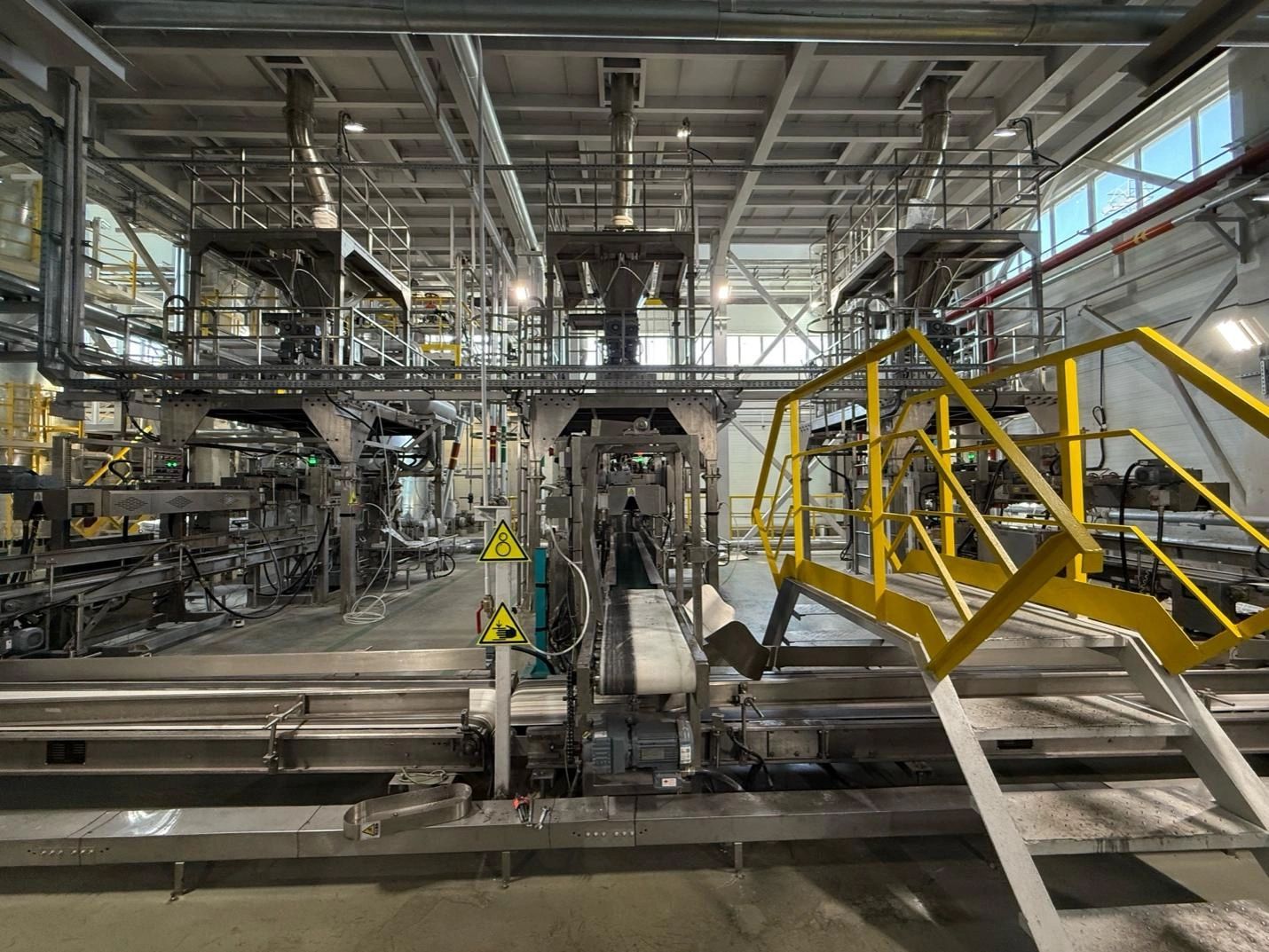
In numerous projects, an optimal solution often involves combining multiple conveyor types rather than relying on a single system. A typical configuration includes a screw conveyor for flaker discharge, a bucket elevator for product elevation, a belt conveyor for buffer transfer, and a screw or vibratory feeder for precise metered feed to packaging. This integrated approach enhances overall plant performance compared to using a single conveying principle throughout the process.

COPYRIGHT © 2000-2026 TIANJIN HUABANG NEW MATERIAL TECHNOLOGY CO., LTD. - ALL RIGHTS RESERVED.
This website uses cookies. By continuing to use this site, you accept our use of cookies.
